Built on Bedrock: Dock on a Rock and Pinning Solutions
- Jan 19
- 3 min read
Updated: Mar 1
Proven Dock Attachment Methods for the Canadian Shield
Dock on a Rock Pining to Shore Bedrock Pinning to Shore Bedrock
When your shoreline is solid bedrock, traditional shoreline construction methods often do not apply. Across the Canadian Shield, cottages are commonly built on exposed granite and hard rock shorelines, and docks need to be installed in a way that works with the rock rather than against it.
Two of the most reliable and widely used methods in these conditions are Dock on a Rock installations and pinning to rock. Both approaches are designed specifically for bedrock shorelines and provide long-term stability when done correctly.
What Is “Dock on a Rock”?
Dock on a Rock - Arm Install Dock on a Rock - Framing Dock on a Rock - Decking
“Dock on a Rock” refers to installing a dock so it bears directly on exposed bedrock at the shoreline. Rather than altering the shoreline or building up material, the dock is carefully fitted to the natural rock surface.
In Ontario, this approach is commonly supported by specialized hardware systems supplied by companies such as Dock On A Rock Inc., based in Wasaga Beach. Their systems are designed specifically for rocky shorelines where traditional dock mounting methods are not practical.
How Dock on a Rock Works
The shoreline contact point is selected on solid, stable bedrock.
Adjustable brackets or landing frameworks are secured directly to the rock.
The dock frame is set to transition cleanly from rock to water while remaining level and supported.
Why It Works on the Canadian Shield
Granite bedrock provides a permanent, non-shifting foundation.
No soil disturbance or shoreline modification is required.
Hardware systems can be adjusted to accommodate sloped or uneven rock.
This method is ideal for shorelines where exposed rock shelves, sloping granite, or stepped bedrock are present.
Key Benefits
Clean, simple shoreline transition
Extremely durable foundation
No excavation or shoreline alteration
Ideal for exposed granite and uneven rock faces
This approach is especially popular where the shoreline is steep, uneven, or completely rock with little to no soil present.
What Does “Pinning to Rock” Mean?
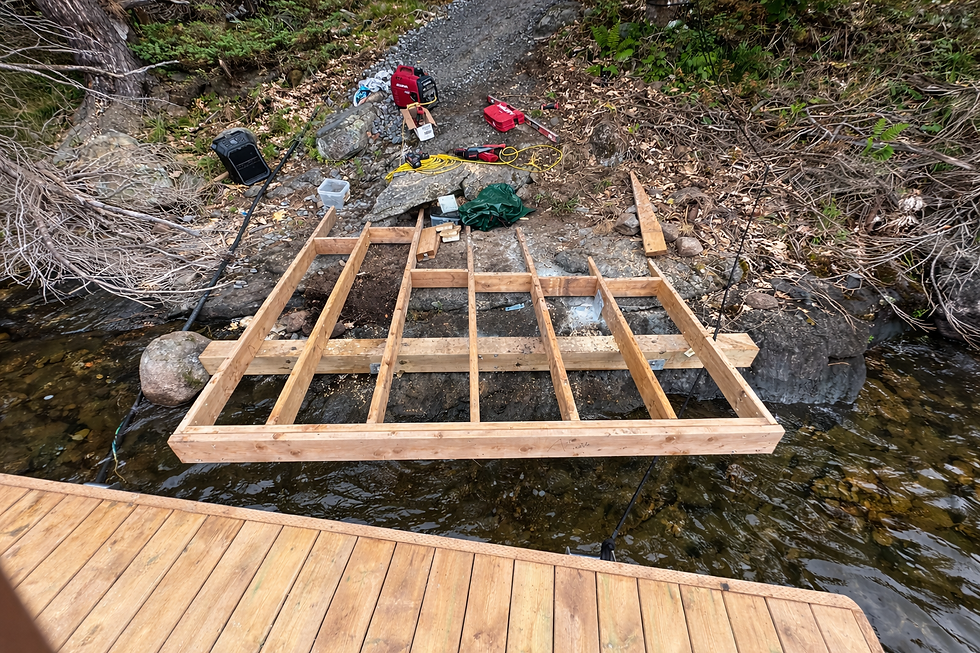
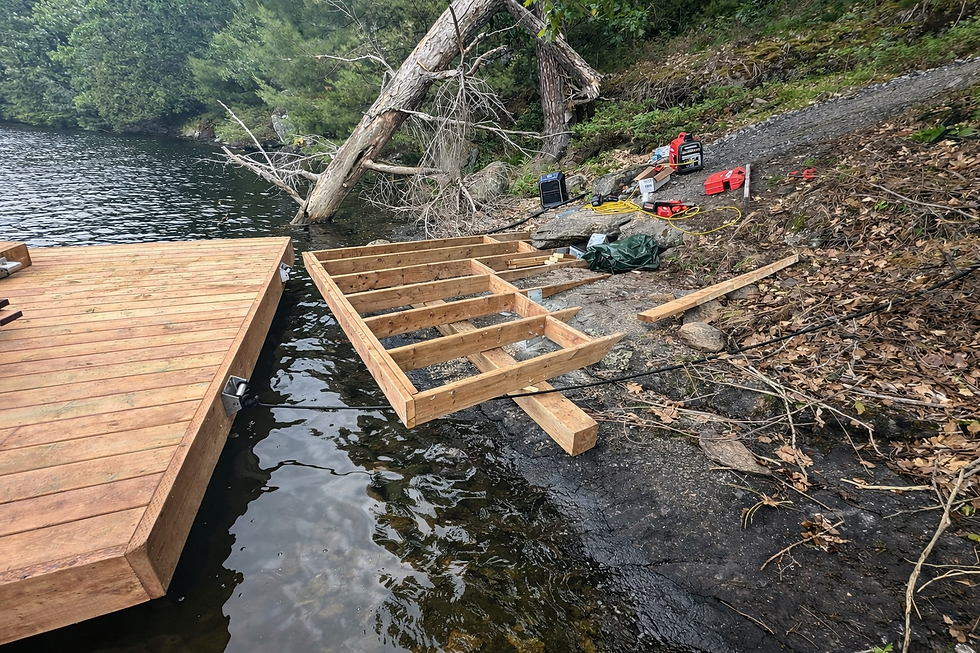
Pining to Bedrock - Framing Pining to Bedrock - Framing 2 Pining to Bedrock - Completed
Pinning to rock involves mechanically fastening the dock structure directly into bedrock using drilled pins or bolts. This method physically locks the dock in place at the shoreline.
How Pinning Is Done
Holes are drilled into solid bedrock using specialized equipment.
Steel pins, rod, or bolts are set into the rock.
The dock frame is secured to these fixed points.
Why Pinning Is Effective
Bedrock offers unmatched holding strength.
The dock is restrained from lateral movement.
Ideal for exposed locations or areas with elevation changes.
Key Benefits
Strong, permanent shoreline attachment
Excellent resistance to movement
Works on steep or irregular rock faces
Long service life with minimal maintenance
Pinning is commonly used where docks meet bare granite shelves or vertical rock edges and where precision alignment is important.
Dock on a Rock vs. Pinning to Rock
Feature | Dock on a Rock | Pinning to Rock |
Shoreline Type | Flat or stepped bedrock | Flat bedrock |
Attachment Style | Dock on a Rock arm | Dock is mechanically fastened |
Visual Impact | Very minimal | Very minimal |
Permanence | Permanent | Permanent |
Ideal Use | Natural shoreline transition | High stability and restraint |
In some installations, both methods are used together. A dock may rest on rock while also being pinned to prevent movement and maintain alignment over time.
Why These Methods Are Ideal for the Canadian Shield
The Canadian Shield presents unique challenges and advantages:
Solid granite bedrock
Minimal soil depth
Irregular and sloped shorelines
Long-term stability once installed
Dock on a Rock and pinning methods are designed specifically for these conditions. They respect the natural landscape, reduce environmental impact, and provide a stable, long-lasting dock solution without altering the shoreline.
Final Thoughts
If your cottage shoreline is rock, you are actually starting with one of the best possible foundations for a dock. When properly designed and installed, Dock on a Rock and pinning to rock provide clean, strong, and reliable dock connections that are perfectly suited to Canadian Shield properties.
These methods have been used successfully for decades across Ontario and beyond, offering cottage owners peace of mind and a dock that feels solid underfoot for years to come.