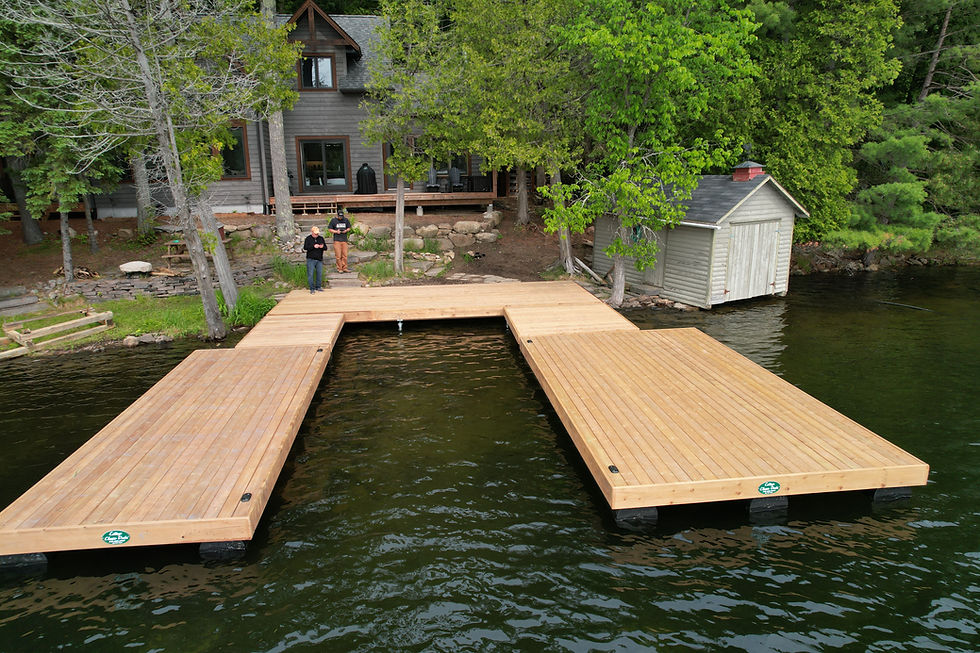
How to Plan Your Dock Layout for Boats, Swimming, and Entertaining

Designing the right dock layout is not just about square footage. It is about how you actually use your waterfront.
Are you docking a boat every day?Do the kids live off the swim ladder all summer?Do you host big cottage weekends with chairs, coolers, and paddle-boards everywhere?
The right layout makes your dock feel effortless. The wrong layout feels crowded and frustrating.
Here is how to think it through properly.
Step 1: Decide What Your Dock Is Primarily For
Before choosing a shape or size, identify the main purpose.
🚤 Boat-Focused Setup
If you have a pontoon boat, wake boat, or fishing boat:
You need proper depth at the docking side
Clear approach angles
Protection from prevailing winds
Room to walk safely around the boat
A straight run dock works well for smaller setups. Generally the dock length will be the same, or close to, the boat length.
🏊 Swim-Focused Setup
If swimming is the priority:
Wider 10' platforms feel dramatically better
Dedicated ladder access is key
Keep boat traffic away from swimmers
Consider deeper water placement
A 12x24 platform in a T layout gives you:
Jumping space
Lounge chair room
Clear swim entry
For many Muskoka & Parry Sound families, this becomes the social hub.
🍹 Entertaining & Lounging
If your dock turns into the cottage patio:
Think width first
8 feet is walk-able but not lounge-friendly. Typically for boot mooring
10 feet wide starts to feel usable - Good mix of lounge of boot mooring
12 feet wide feels premium and lounging is comfortable. Great for mixed use. Add a 3rd pontoon for added stability.
16 feet and more is ready to party.
Step 2: Choose the Right Layout Shape
Straight Run
Simple and cost effective.
Best for:
Smaller shorelines
Minimal boat traffic
Budget friendly installs
Limitation: Limited gathering space.
L-Shape
Great balance of boat + swim.
One side for docking
One side for lounging
Adds stability and functionality without dramatically increasing footprint.
T-Shape
Excellent for entertaining.
Central walkway
Large platform at end
Clear boat tie-up areas
This is often ideal for families who swim and host.
Step 3: Consider Your Shoreline Type For Your Shore Anchoring Point
Rock shelf, sand entry, or deep water drop-off all impact layout decisions.
On rocky shorelines, you may need:
Pinning solutions
Helical piles for stability
Careful alignment to avoid shallow sections
On sand:
Anchoring and weight placement matter
Dock orientation should account for wind and wave movement
The shoreline dictates more than most people realize.
Step 4: Think About Future Expansion
A common mistake is building exactly what you need today.
Consider:
Will you upgrade your boat?
Will kids get older and need more space?
Do you plan to add a boat port or PWC lifts?
Modular floating systems allow you to expand later without replacing everything.
Planning that into your layout now saves money long term.
Step 5: Safety and Flow Matter
Good dock layouts:
Separate boat tie-ups from swim ladders
Keep clear walking lanes
Avoid tight corners in high traffic areas
Ensure stable, even free-board across sections
Weight distribution and pontoon sizing affect how solid your dock feels underfoot. Stability changes the entire experience.
Common Layout Mistakes
Making the walkway too narrow for furniture
Placing ladders too close to boat areas
Not accounting for water level fluctuations
Underestimating entertaining space
Ignoring wind direction
A well-planned dock feels bigger than it measures.
Final Thoughts
The best dock layout is one that matches your lifestyle, not just your shoreline.
For most cottage owners in Muskoka and surrounding lakes, the sweet spot tends to be:
10 foot wide minimum for mixed usability
L or T configuration for flexibility
A dedicated swim zone
Proper anchoring for long-term stability
If you are unsure what shape fits your waterfront, sketching it out with your intended use in mind is the best first step.
And remember, docks are not just structures. They are where summer happens.
Stright out dock